
When Ice Becomes Evidence: How a $44.1M Verdict Redefined Winter Driving Liability
By SafetyLane editorial staff
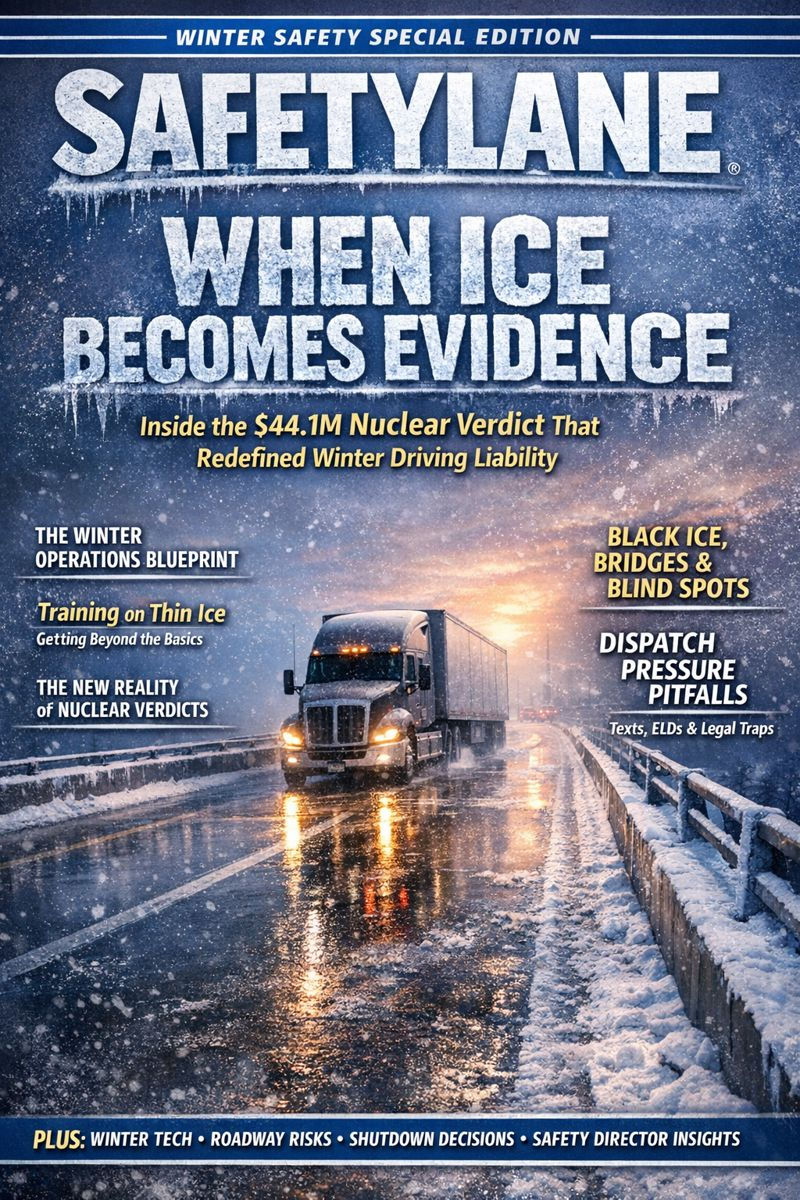
The transportation industry continues to witness the rise of nuclear verdicts—massive jury awards that reshape the expectations placed on motor carriers, their safety programs, and their operational culture. One of the most significant recent examples is the $44.1 million verdict against a major trucking company following the catastrophic February 2021 pileup on the I-35W TEXpress lanes in Fort Worth, Texas, during Winter Storm Uri.
This article breaks down the case, the factors that influenced the jury’s decision, and—most importantly—the safety and compliance lessons that every carrier should take seriously. As winter approaches nationwide, this verdict offers a sobering reminder: adverse weather is not a defense—poor risk management is an exposure.
The Incident: A Perfect Storm of Weather, Traffic, and Risk
On the morning of February 11, 2021, a deadly chain-reaction collision occurred on an elevated, iced-over toll segment of I-35W. The crash involved approximately 130 vehicles, resulted in six fatalities, and became one of the most widely studied multi-vehicle pileups in recent history.
Cold temperatures had hovered below freezing for more than a day, and road surfaces—particularly elevated sections—were dangerously slick. Dynamic message boards warned drivers of potential ice, but actual conditions deteriorated faster than anticipated.
Within this chaos, a tractor-trailer operated by a national carrier struck traffic that had already come to a stop. One of the victims was Christopher Ray Vardy, 49, whose family later pursued legal action.
The Verdict: $44.1 Million and a Clear Message
A Texas jury awarded $24.1 million in compensatory damages and $20 million in punitive damages, holding the trucking company and its driver responsible for Vardy’s death.
Punitive damages are reserved for conduct considered reckless, indifferent, or consciously disregarding safety risks. In this case, the jury concluded that safety system failures contributed to conditions leading up to the crash.
The verdict sends a message that resonates throughout the trucking industry: Weather conditions do not remove a carrier’s duty to operate safely—they intensify it.
Key Allegations That Influenced the Jury
1. Speed for Conditions
Although the truck may not have been traveling above the posted speed limit, evidence suggested it was too fast for the icy roadway, given limited visibility and rapidly changing traffic conditions.
2. Adequacy of Winter-Weather Training
The plaintiffs argued the driver lacked sufficient winter operations training, particularly for driving on elevated structures, recognizing black ice, and adjusting following distance.
In today’s courtroom environment, basic training is not enough—training must be specialized, documented, and enforced.
3. Hiring and Driver Fitness Review
The company faced allegations of having employed a driver who was unfit or inadequately prepared for extreme winter operation—an argument often used by plaintiffs to support punitive damages.
4. Company Safety Culture and Decision-Making
While no one sets out to cause harm, juries focus heavily on patterns, procedures, and organizational behavior. If a plaintiff can show:
dispatch pressure,
weak shutdown policies,
a lack of documented coaching, or
inadequate supervision,
the company becomes the target—not just the driver.
Contributing Factors Identified by Safety Investigators
Beyond the litigation, safety agencies identified several systemic contributors:
Roadway Monitoring Gaps
The elevated toll lanes were not treated or de-iced in time to prevent dangerous icing, highlighting failures in roadway hazard detection and response.
Insufficient Weather Monitoring Training for Roadway Personnel
The investigation suggested that roadway managers lacked clear winter-weather protocols, leading to inconsistent and inadequate treatment decisions.
Lack of Hazard Detection Technology
Environmental sensors, real-time friction measurement systems, and connected-vehicle hazard alerts can provide early warning. Their absence played a role in conditions worsening unnoticed.
While these issues are not controlled by motor carriers, they do not reduce liability. Carriers must demonstrate that they operate defensively regardless of infrastructure failures.
SafetyLane Guidance: Lessons Every Carrier Must Apply
1. Write—and Enforce—a Winter Operations Policy
A strong policy should include:
Defined shutdown triggers (temperature, precipitation, roadway treatment status)
Dispatch decision protocols
Documentation requirements for adverse-weather decisions
Driver authority to stop without fear of retaliation
If it’s not written, it cannot defend you.

2. Provide Meaningful, Practical Winter Training
Winter training must cover:
Speed management
Traction loss recognition
Elevated roadway risks
Increased stopping distance
Safe following distance
Visual clues for black ice
Techniques for controlled braking and steering
Training must also be tested, refreshed seasonally, and recorded.
3. Strengthen Driver Qualification and Monitoring
Because “unfit driver” claims are often central to punitive damage awards, carriers must maintain:
Thorough background checks
Safety performance evaluations
Documented hiring rationale
Coaching records and corrective action plans
30/60/90-day post-hire reviews
A carrier must be able to prove it made a thoughtful, safety-driven hiring decision.
4. Eliminate Real or Perceived Dispatch Pressure
Dispatch communications are discoverable in court. Juries look for:
Hints of prioritizing delivery over safety
Messages encouraging “push through” behavior
Lack of support for shutdown decisions
Create a culture where stopping is a safety success, not a failure.
5. Use Technology as a Safety Force-Multiplier
While technology cannot eliminate weather risks, it can:
Provide early warning of slippery conditions
Highlight bridge and overpass danger zones
Integrate weather data into route planning
Send alerts directly to driver tablets or ELD screens
Carriers should implement winter-specific telematics alerts, automated weather monitoring, and proactive routing.
The Big Picture: Why This Verdict Matters
This case reinforces a crucial reality:
A trucking company is judged not by its intentions, but by its systems.
Weather does not absolve a carrier—it challenges its preparedness. Infrastructure deficiencies do not reduce liability—they increase the expectations placed on trained professionals.
With nuclear verdicts becoming more common nationwide, proactive safety management is the only path forward.
Conclusion
The $44.1 million Winter Storm Uri verdict is more than a tragic event—it is a blueprint showing how plaintiffs build cases, how juries think, and how carriers must evolve their safety programs.
For safety leaders, fleet managers, and owner-operators, the message is clear:
Winter is not an excuse. Winter is a test—and preparedness is the only passing grade.


Comments