
CVSA 2026 Out-of-Service Criteria: A New Enforcement Era for Carriers and Drivers
By SafetyLane Editorial Team
Effective April 1, 2026, the Commercial Vehicle Safety Alliance (CVSA) has officially implemented the updated North American Standard Out-of-Service Criteria (OOSC)—a regulatory framework that continues to shape the frontline of commercial motor vehicle enforcement across the United States, Canada, and Mexico
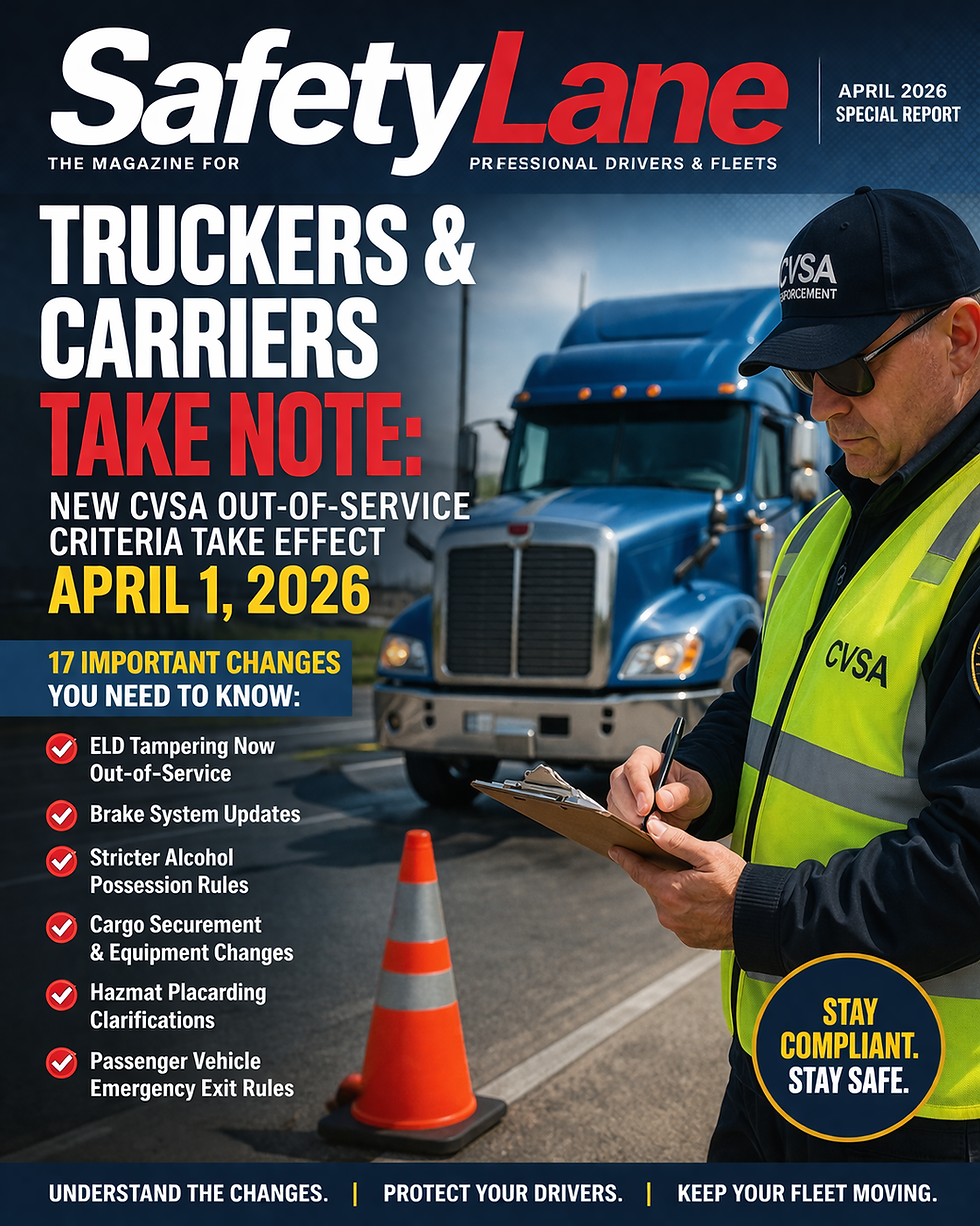
With 17 approved changes, this year’s update is not merely technical—it represents a significant shift in how enforcement agencies interpret driver compliance, electronic logging devices (ELDs), brake systems, cargo securement, and hazardous materials regulations.
For motor carriers, safety directors, and professional drivers, understanding these changes is no longer optional—it is operationally critical.
Understanding the Purpose: “Imminent Hazard” Enforcement
At its core, the Out-of-Service Criteria exists to answer one question:
Does this driver or vehicle pose an imminent hazard to public safety?
If the answer is yes, enforcement officials have the authority to immediately remove the driver or vehicle from operation.
The 2026 revisions sharpen that determination—particularly in areas where ambiguity previously allowed unsafe practices to go undetected.
Driver-Focused Changes: Accountability Tightened
1. CDL Endorsements and Restrictions — Clarity Over Confusion
The updated criteria now separates endorsements from restrictions, eliminating long-standing confusion in roadside enforcement.
Key takeaway:
A restriction violation does not automatically invalidate a CDL
Enforcement actions now depend on state authority and context of operation
This places increased responsibility on:
Safety departments to properly qualify drivers
Dispatch teams to align loads with driver restrictions
2. Alcohol Possession — Zero Tolerance Defined Clearly
The revised rule removes ambiguity:
Any beer or wine above 0.5% alcohol
Any distilled spirit
➡️ Results in immediate out-of-service status
This clarification closes loopholes that previously allowed arguments around “non-intoxicating” beverages.
3. ELD Tampering — Now a Direct Out-of-Service Violation
Perhaps the most consequential update of 2026 is the formal classification of ELD tampering as an out-of-service condition.
Unlike traditional log violations, the new criteria distinguishes between:
False logs (detectable and reconstructable)
Tampered ELD data (unreliable and unverifiable)
If an inspector cannot determine actual driving or rest periods, the driver is automatically:
➡️ Placed out-of-service for a minimum of 10 hours
This reflects a growing enforcement concern:
Manipulated logs have been found shifted by days
Drivers recorded hundreds of miles away from actual locations
Some carriers have created fraudulent driver accounts to extend drive time
Industry Implication: ELD compliance is no longer just a paperwork issue—it is now a direct safety enforcement trigger with immediate operational consequences.
Vehicle and Equipment: Precision Enforcement Expands
4. Brake Systems — Alignment with Federal Standards
Key updates include:
Integration of additional violations into the 20% defective brake threshold
Updated measurement standards for lining thickness
Terminology shift from “gladhands” to “service air connections”
These changes reflect a move toward:
Standardization across equipment types
Reduced interpretation variability during inspections
5. Parking Brake Redefined
The category now reads:
➡️ “Parking/Emergency Brake”
This acknowledges the dual function of modern braking systems and reinforces enforcement consistency.
6. Wheels, Rims, and Hubs — Eliminating Grey Areas
Updates include:
Addressing missing rim components
Removing outdated references (e.g., center holes)
Eliminating one hub-related out-of-service condition due to inconsistent enforcement
Impact: Inspectors now operate with clearer defect criteria, reducing disputes at roadside.
Cargo Securement: Modern Systems Recognized
The addition of the ExTe Com90 securement system signals recognition of evolving industry technology.
Additionally:
A wire rope damage chart has been introduced
New provisions for countersunk screws in coupling devices
Why it matters: Cargo securement violations remain a top focus area—especially with CVSA’s International Roadcheck emphasizing load securement in 2026.
Passenger Carrier Safety: Emergency Exit Enforcement
A new out-of-service condition now applies when:
➡️ Emergency exits are marked but lack operating instructions
This is a critical update for:
Motorcoach operators
Passenger van services
Shuttle operations
Hazardous Materials: Placarding Clarified
The revised language eliminates ambiguity:
If a vehicle is missing placards for multiple divisions within the same hazard class,
➡️ It must be placed out-of-service
This reinforces strict adherence to:
49 CFR hazmat communication standards
Immediate visual identification requirements for first responders
New Federal Out-of-Service Orders Framework
Part IV now includes a structured chart outlining seven types of federal out-of-service orders, improving:
Enforcement consistency
Carrier understanding of penalties
Legal defensibility of inspections
What This Means for Carriers
The 2026 OOSC changes reflect a clear regulatory direction:
1. Enforcement is becoming more data-driven
Inspectors are increasingly using:
Supporting documents (fuel receipts, GPS, toll data)
Cross-verification against ELD records
2. Technology misuse is now a primary target
ELD tampering is treated as:
A safety violation
A compliance failure
In some jurisdictions, a criminal offense
3. “Technical violations” can now stop operations
Many updates close loopholes that previously allowed carriers to continue operating despite deficiencies.
Strategic Recommendations for Safety Departments
To remain compliant under the new criteria, carriers should:
Audit ELD systems and providers immediately
Train drivers on:
Proper duty status recording
Consequences of tampering
Review:
Brake maintenance programs
Cargo securement procedures
Hazmat placarding protocols
Verify driver qualification files for:
Restrictions
Endorsements
Route compliance
Final Thought: Compliance is Now Operational Survival
The 2026 CVSA Out-of-Service Criteria marks a decisive shift toward zero tolerance for ambiguity, manipulation, and preventable risk.
For carriers, the message is clear:
Compliance is no longer just about avoiding fines—it is about staying on the road.


Comments